Thanks to Gerard O'Neill of Turbulence Ahead for publishing yet another of the international comparisons that allow us to see how well – or badly – we are doing compared to other western countries.
This one looks at our image of politicians. Needless to say it doesn't include Northern Ireland separately, but it would be surprising if Northern Irish people trusted their politicians any more than the average western European.
But one country stands out, as almost always in comparative surveys, no matter what the topic – Sweden.
In Sweden 43.8% of people have a 'rather favourable' opinion of their politicians, compared with an EU average of 12.4%. And only 18.4% of Swedes have a 'rather unfavourable' opinion, against the EU average of 55.4%.
Swedes are not foolish people, and are no more likely to be fooled by their politicians than anyone else, so what these results show is that Swedish politicians are simply better than any others. If their voters have a positive opinion of them it must be because they are more honest, more diligent, more representative and more efficient than any others.
And, of course, good politicians lead to good politics and good governance – and these lead, almost inevitably, to a more responsive state in which the needs of the people are served better than elsewhere. No wonder Sweden is close to the top of the list in almost every international comparison, whether it is looking at freedom, affluence, education, development or happiness.
Whatever it is that Swedish politicians are doing, they are doing it well, and their voters are happy with them. We need to learn from them.
Showing posts with label Miscellaneous. Show all posts
Showing posts with label Miscellaneous. Show all posts
Monday 7 June 2010


Tuesday 1 June 2010
All-island or all-Ireland?
Elaine Byrne spoils an otherwise interesting article in today's Irish Times by making an unrelated and unnecessarily political point in the last line.
But the overall content of her article is positive. She argues that civic society is quietly creating an 'all-island' approach, in areas like sport and trade, and that it is time that politics caught up.
Byrne is particularly positive about Martin McGuinness, who, as the Stormont institutions bed in, is growing in stature. As she points out, he is increasingly demonstrating a spirit of true republicanism:
The article notes the improvement in north-south co-operation between the two justice ministers, and that even DUP Finance Minister Sammy Wilson acknowledges that infrastructure investment and economic growth are intrinsically linked between North and South, necessitating an all-island, if not (yet) an all-Ireland approach.
Small steps, to be sure – but steps in the right direction.
But the overall content of her article is positive. She argues that civic society is quietly creating an 'all-island' approach, in areas like sport and trade, and that it is time that politics caught up.
Byrne is particularly positive about Martin McGuinness, who, as the Stormont institutions bed in, is growing in stature. As she points out, he is increasingly demonstrating a spirit of true republicanism:
In the same breath as his call to commemorate the centenary of the Easter Rising, McGuinness noted that “it is equally right to recognise the sacrifice of those who fought in the first World War” because, he believed, “the experiences of republicans, nationalists, unionists and all others form part of our collective memory. They are part of who we are, as a nation, and as a community.”She notes that the recent Westminster election showed that "instead of looking to the United Kingdom for political direction, a majority of unionists now seek to determine their own future within the context of a Northern Assembly that is beginning to bed down", and that Martin McGuinness's attempts at reconciliation are aimed at reassuring them that, in the case of him becoming First Minister next year, the sky will not fall.
The article notes the improvement in north-south co-operation between the two justice ministers, and that even DUP Finance Minister Sammy Wilson acknowledges that infrastructure investment and economic growth are intrinsically linked between North and South, necessitating an all-island, if not (yet) an all-Ireland approach.
Small steps, to be sure – but steps in the right direction.
Monday 31 May 2010
The battle for 1916
In Ireland anniversaries matter, and in the republican calendar none matter more than 1916. As this blog pointed out in November 2009, the country faces a decade of centenaries, with 2016 being a particularly important one. The southern establishment seems to have decided that it needs to reclaim 'ownership' of the key dates in the struggle for partial independence.
Part of the reason why the southern ('official republican') establishment wanted to reclaim the past was to stop the more shadowy dissident republican groups claiming it.
Today the Irish Times has published a letter from Des Dalton, President of Republican Sinn Féin, in which he stakes his party's claim to 1916:
The single best hope for the dissidents is that some of Ireland's contrarians will provide them with space. Already the 'contrarian-in-chief', Kevin Myers (ex-Irish Times, now Irish Independent columnist) has signalled loudly that he will use his undeniably powerful writing skills to counter the celebration of the Easter Rising, the war of Independence, and anything else that nationalism holds dear. By doing so, of course, he will spark a reaction that will play right into the hands of the dissidents.
The other main contrarians on the island are, of course, the unionists – in so far as they systematically act and speak counter to the prevailing nationalist discourse. However, the unionist position is old, predictable and discounted by most people on the nationalist side of the fence. So when Nelson McCausland uses his position as Minister of Culture to try to pour cold water on the commemorations, nobody will be surprised or even very interested.
The battle for 1916 will be fought within the nationalist family, and so far it is shaping up to be extremely one-sided. As Republican Sinn Féin (and it's comrades-in-arms, the Continuity IRA) appear to be suffering from internal tensions (as reported in the Irish News, for which no link is available, but which is quoted on the Slugger O'Toole blog), there may not even be a coherent 'dissident republican' organisation left by 2016. This would be no great loss.
1916 was history, and its context was widely different from today's. Nationalist Ireland should remember 1916 with pride and with interest, but should not try to map its context onto that of 2016. Instead it should gather the memories of the Home Rule struggle, the Rising, the War of Independence, the civil war, and so on, and commemorate them as past events, while dealing in a 21st century manner with the issues of the 21st century. One of the essential requirements, of course, is that groups like Republican Sinn Féin, which seek to refight the battles of the past, must be marginalised. In that respect, the decision of the southern state to reclaim its past is the right one.
Part of the reason why the southern ('official republican') establishment wanted to reclaim the past was to stop the more shadowy dissident republican groups claiming it.
Today the Irish Times has published a letter from Des Dalton, President of Republican Sinn Féin, in which he stakes his party's claim to 1916:
"Madam, – Speaking in UCD on May 20th, the head of the 26-county administration Brian Cowen accused Irish republicans of seeking to “hijack” the centenary of the 1916 Rising (Home News, May 20th). It is an accusation that does not stand up; republicans cannot hijack something they have never abandoned. Irish republicans will commemorate the centenary of 1916 as well as the anniversaries of the other landmark events in Irish revolutionary history, just as we have in the past.The next few years will be crucial for dissident republicanism. If it fails to exploit the past – and usurp ownership of it – it will become increasingly irrelevant. But faced with the 'big guns' of the southern establishment and the two main northern nationalist parties, they will struggle to be heard. The southern state will hold increasingly confident celebrations, helped by academia, the media and its monopoly of diplomacy – and the dissidents will look pathetic in comparison.
Each year Irish republicans both in Ireland and abroad have commemorated 1916 without fail. The 26-county state on the other hand has alternated between ignoring the anniversary and banning commemoration of it. 1916 commemorations throughout the 26 counties were banned by the Dublin administration in 1937. In 1976 republicans were prosecuted – including Fiona Plunkett sister of Joseph Mary Plunkett – and some jailed for their participation in a banned commemoration at the GPO. Each year republicans face the prospect of prosecution for selling Easter lilys.
For 40 years the 26-county administration ignored the anniversary of 1916, but since 2006 it has opportunistically seized on it in order to sell the big lie that history has come to an end and British rule in Ireland is now accepted.
1916 remains unfinished business while Britain holds any part of Ireland.
The message of 1916 could not be clearer; “Ireland unfree shall never be at peace”. – Yours, etc,"
The single best hope for the dissidents is that some of Ireland's contrarians will provide them with space. Already the 'contrarian-in-chief', Kevin Myers (ex-Irish Times, now Irish Independent columnist) has signalled loudly that he will use his undeniably powerful writing skills to counter the celebration of the Easter Rising, the war of Independence, and anything else that nationalism holds dear. By doing so, of course, he will spark a reaction that will play right into the hands of the dissidents.
The other main contrarians on the island are, of course, the unionists – in so far as they systematically act and speak counter to the prevailing nationalist discourse. However, the unionist position is old, predictable and discounted by most people on the nationalist side of the fence. So when Nelson McCausland uses his position as Minister of Culture to try to pour cold water on the commemorations, nobody will be surprised or even very interested.
The battle for 1916 will be fought within the nationalist family, and so far it is shaping up to be extremely one-sided. As Republican Sinn Féin (and it's comrades-in-arms, the Continuity IRA) appear to be suffering from internal tensions (as reported in the Irish News, for which no link is available, but which is quoted on the Slugger O'Toole blog), there may not even be a coherent 'dissident republican' organisation left by 2016. This would be no great loss.
1916 was history, and its context was widely different from today's. Nationalist Ireland should remember 1916 with pride and with interest, but should not try to map its context onto that of 2016. Instead it should gather the memories of the Home Rule struggle, the Rising, the War of Independence, the civil war, and so on, and commemorate them as past events, while dealing in a 21st century manner with the issues of the 21st century. One of the essential requirements, of course, is that groups like Republican Sinn Féin, which seek to refight the battles of the past, must be marginalised. In that respect, the decision of the southern state to reclaim its past is the right one.
Friday 28 May 2010
Boo hoo!
So Bobby Moffat, a member of the Red Hand Commando, has been shot dead.
Matthew verse 26:52 is the appropriate biblical quotation for those of a religious nature.
This blog is irreligious, but shares the sentiment.
One less blood-stained loyalist scumbag on the streets of Belfast can only be a good thing. The reporters who reported on his death knew who he was and what he was - why were they so silent while he was alive? Whose deaths was he responsible for? Which families still grieve because of his sadism? Journalistic collusion is no better than police collusion.
Who killed him? Which loyalist group kept the guns that they claimed to have decommissioned? Will Moffatt's brothers in brutality respond in kind? Hopefully. But hopefully they will kill only other loyalists. Lots of them.
Matthew verse 26:52 is the appropriate biblical quotation for those of a religious nature.
This blog is irreligious, but shares the sentiment.
One less blood-stained loyalist scumbag on the streets of Belfast can only be a good thing. The reporters who reported on his death knew who he was and what he was - why were they so silent while he was alive? Whose deaths was he responsible for? Which families still grieve because of his sadism? Journalistic collusion is no better than police collusion.
Who killed him? Which loyalist group kept the guns that they claimed to have decommissioned? Will Moffatt's brothers in brutality respond in kind? Hopefully. But hopefully they will kill only other loyalists. Lots of them.
Thursday 27 May 2010
When an old woman dies
There may be a secret injunction that prevents the discussion of the following issue, or maybe people just feel uncomfortable even thinking about it, but it is time the silence was broken.
There is an old woman called Elizabeth – many people may have seen her still at work this week. Unlike many of us she cannot retire – like the Pope she will die in office. She is now 84 years old, but longevity in not unknown in her family – her mother lived to be 101. Nonetheless, the life expectancy for females in the region in which she lives is around 83. If you add a few years for good behaviour, and the best medical care that other people’s taxes can buy, she will certainly exceed the average – but by how many years?
When she dies – and she will – what will the impact be, particularly in Northern Ireland? For many people she is the only head of the British state that they have known – she started work when Stalin still ruled the Soviet Union, and has outlasted almost every other head of state in the world. She inherited her job in the aftermath of World War II, a time when Britain still had an empire and delusions of power.
The nationalist side of the north's population – certainly younger members – will not be greatly upset by her death. But the unionist side, especially the large numbers of old unionists who identify more closely with the glory days of empire, might see her death as the end of an era.
For many unionists she provides continuity with the past, and with a time when unionism was undoubtedly dominant. But 58 years on, much has changed – the empire is gone, and Britain is barely a middle-ranking European country. Northern Ireland, so unionist in 1952, is now more evenly balanced.
For many, the mere act of transfer – the famous ‘the king is dead, long live the king’ moment – will be revolutionary, and will cause them to stop and ask whether this is really the best model for the 21st century. At a time when the hereditary House of Lords is being seriously re-thought, can the questioning of a hereditary head of state be far behind?
No doubt some unionists will use the death of their Queen as an opportunity to try to promote their view of the world. Some will be genuinely upset – and the Princess Diana effect, where people experience some connection with a celebrity who they have never actually known, will no doubt reappear. Every unionist-controlled council will pass the obligatory obsequious motion of devoted loyalty, and they will try to brow-beat nationalists to join in. Nationalists, if they are polite, will express sympathy on the death of the British head of state, but will hopefully resist all the unionist attempts to drag them to their knees. Nationalist Ireland should let its President represent it, with all the pomp and formality that she wishes.
Elizabeth is a strictly formal figurehead who has never put a foot wrong, but her heir, Charles, is less revered by unionists, and for the more religious amongst them he is anathema thanks to his somewhat salacious private life. Paradoxically, he is probably more popular with nationalists that Elizabeth is – he can, and does, visit the south with no problem and is well received there.
Attempts to transfer the carefully constructed loyalty to Elizabeth to her son may not succeed, however – even amongst unionists. The death of Elizabeth may represent another irreversible step in Northern Ireland’s parting from Britain. Charles will not occupy the ‘sainted’ position that his mother currently occupies. The monarchy will become more head of state than god.
And if Charles cannot win the hearts of Northern Ireland’s unionists, then where will their loyalty lie? It is often said that they owe their loyalty to the crown as an institution rather than just a person. But if they do not respect the personification of that crown, how can they truly be loyal to it?
There is an old woman called Elizabeth – many people may have seen her still at work this week. Unlike many of us she cannot retire – like the Pope she will die in office. She is now 84 years old, but longevity in not unknown in her family – her mother lived to be 101. Nonetheless, the life expectancy for females in the region in which she lives is around 83. If you add a few years for good behaviour, and the best medical care that other people’s taxes can buy, she will certainly exceed the average – but by how many years?
When she dies – and she will – what will the impact be, particularly in Northern Ireland? For many people she is the only head of the British state that they have known – she started work when Stalin still ruled the Soviet Union, and has outlasted almost every other head of state in the world. She inherited her job in the aftermath of World War II, a time when Britain still had an empire and delusions of power.
The nationalist side of the north's population – certainly younger members – will not be greatly upset by her death. But the unionist side, especially the large numbers of old unionists who identify more closely with the glory days of empire, might see her death as the end of an era.
For many unionists she provides continuity with the past, and with a time when unionism was undoubtedly dominant. But 58 years on, much has changed – the empire is gone, and Britain is barely a middle-ranking European country. Northern Ireland, so unionist in 1952, is now more evenly balanced.
For many, the mere act of transfer – the famous ‘the king is dead, long live the king’ moment – will be revolutionary, and will cause them to stop and ask whether this is really the best model for the 21st century. At a time when the hereditary House of Lords is being seriously re-thought, can the questioning of a hereditary head of state be far behind?
No doubt some unionists will use the death of their Queen as an opportunity to try to promote their view of the world. Some will be genuinely upset – and the Princess Diana effect, where people experience some connection with a celebrity who they have never actually known, will no doubt reappear. Every unionist-controlled council will pass the obligatory obsequious motion of devoted loyalty, and they will try to brow-beat nationalists to join in. Nationalists, if they are polite, will express sympathy on the death of the British head of state, but will hopefully resist all the unionist attempts to drag them to their knees. Nationalist Ireland should let its President represent it, with all the pomp and formality that she wishes.
Elizabeth is a strictly formal figurehead who has never put a foot wrong, but her heir, Charles, is less revered by unionists, and for the more religious amongst them he is anathema thanks to his somewhat salacious private life. Paradoxically, he is probably more popular with nationalists that Elizabeth is – he can, and does, visit the south with no problem and is well received there.
Attempts to transfer the carefully constructed loyalty to Elizabeth to her son may not succeed, however – even amongst unionists. The death of Elizabeth may represent another irreversible step in Northern Ireland’s parting from Britain. Charles will not occupy the ‘sainted’ position that his mother currently occupies. The monarchy will become more head of state than god.
And if Charles cannot win the hearts of Northern Ireland’s unionists, then where will their loyalty lie? It is often said that they owe their loyalty to the crown as an institution rather than just a person. But if they do not respect the personification of that crown, how can they truly be loyal to it?
Wednesday 26 May 2010
ABC
That's 'Anything But Celtic' – and must be the new McCausland family motto, judging by the Minister for Culture, Arts and Leisure.
Nelson McCausland – the DUP Minister in question – has just made a fool of himself (again) for writing to Northern Ireland's museums asking them to give more prominence to Ulster-Scots, the Orange Order and 'alternative views on the origin of the universe'.
The first two are, of course, uncontroversial – both are part of what Northern Ireland is, after all. But the third item on McCausland's wish list brings him into the realm of the nutter, and makes him an object of ridicule amongst intelligent people in Northern Ireland and elsewhere.
He has already been publicly dismissed by Richard Dawkins, and will undoubtedly be the object of as much ridicule as his fellow-DUP 'young earther' Edwin Poots.
But there is more to McCausland than merely an incomprehensible belief in creationism – he is trying his best to use his position to advance his own segment of Northern Ireland's society (the Orange, Protestant and Ulster-Scots segment), and to block the recognition of the other segment, the Gaelic, Celtic, Catholic one.
On his own blog (yes, even creationists can use the internet!) he expends considerable energy trying to dispel the notion that Northern Ireland is a 'Celtic' country, or that it forms part of the 'Celtic fringe':
Yesterday: "… we are not a Celtic country in a linguistic sense. Neither are we a Celtic country in an ethnic sense … The use of the term 'Celtic countries' is therefore erroneous."
In April: "The Celtic Media Festival has been taking place this week in Newry and I was invited by Cathal Goan to attend and officially open the annual festival. … Towards the end and in the context of some remarks about a 'shared and better future' I referred to the way in which the festival organisers described the participating countries as 'Celtic nations'. If we are to recongise and respect the cultural diversity of Northern Ireland, is it appropriate to describe us as a Celtic nation? Yes, there are some people who speak a Celtic language and there are many people who will regard themselves as culturally Celtic or even ethnically Celtic but that represents only one element in our diversity. Is there not a need for a terminology that recognises that important fact?"
The Minister appears to have a bit of a bee in his bonnet about the 'Celticness' of Northern Ireland. 'Celticness' itself is a fairly controversial concept, but in general refers to those areas in which that area's own Celtic languages and cultural traits have survived. According to such a definition Northern Ireland certainly has a very good claim to be Celtic. The area was almost exclusively Irish Gaelic before being 'planted' by a mixture of English and Scots – many also of evident Gaelic ancestry – in the 17th century. Nobody denies that there are many people in Northern Ireland whose ancestry includes other origins, but this is true in the south, and in Britain. Should England stop being called 'English' because there are other elements in its diversity? Or France French because of its North African immigrants?
The real irony in this, of course, is that the Minister carries a Gaelic surname, and thus cannot deny the Celticness of his own paternal line.
One definition of the name McCausland is: probably a variant of MacAuslan, which according to Black is an Anglicization of Mac Ausaláin ‘son of Absolom’, from the name of an early 13th-century cleric. However, there may rather be an underlying Gaelic personal name, possibly Caisealán, meaning ‘little one of the castle’.
Is the Minister suffering from a case of autophobia?
Nelson McCausland – the DUP Minister in question – has just made a fool of himself (again) for writing to Northern Ireland's museums asking them to give more prominence to Ulster-Scots, the Orange Order and 'alternative views on the origin of the universe'.
The first two are, of course, uncontroversial – both are part of what Northern Ireland is, after all. But the third item on McCausland's wish list brings him into the realm of the nutter, and makes him an object of ridicule amongst intelligent people in Northern Ireland and elsewhere.
"Without specifically mentioning creationism, Mr McCausland's letter includes a request for the trustees to consider how alternative views of the origin of the universe can be recognised and accommodated".
He has already been publicly dismissed by Richard Dawkins, and will undoubtedly be the object of as much ridicule as his fellow-DUP 'young earther' Edwin Poots.
But there is more to McCausland than merely an incomprehensible belief in creationism – he is trying his best to use his position to advance his own segment of Northern Ireland's society (the Orange, Protestant and Ulster-Scots segment), and to block the recognition of the other segment, the Gaelic, Celtic, Catholic one.
On his own blog (yes, even creationists can use the internet!) he expends considerable energy trying to dispel the notion that Northern Ireland is a 'Celtic' country, or that it forms part of the 'Celtic fringe':
Yesterday: "… we are not a Celtic country in a linguistic sense. Neither are we a Celtic country in an ethnic sense … The use of the term 'Celtic countries' is therefore erroneous."
In April: "The Celtic Media Festival has been taking place this week in Newry and I was invited by Cathal Goan to attend and officially open the annual festival. … Towards the end and in the context of some remarks about a 'shared and better future' I referred to the way in which the festival organisers described the participating countries as 'Celtic nations'. If we are to recongise and respect the cultural diversity of Northern Ireland, is it appropriate to describe us as a Celtic nation? Yes, there are some people who speak a Celtic language and there are many people who will regard themselves as culturally Celtic or even ethnically Celtic but that represents only one element in our diversity. Is there not a need for a terminology that recognises that important fact?"
The Minister appears to have a bit of a bee in his bonnet about the 'Celticness' of Northern Ireland. 'Celticness' itself is a fairly controversial concept, but in general refers to those areas in which that area's own Celtic languages and cultural traits have survived. According to such a definition Northern Ireland certainly has a very good claim to be Celtic. The area was almost exclusively Irish Gaelic before being 'planted' by a mixture of English and Scots – many also of evident Gaelic ancestry – in the 17th century. Nobody denies that there are many people in Northern Ireland whose ancestry includes other origins, but this is true in the south, and in Britain. Should England stop being called 'English' because there are other elements in its diversity? Or France French because of its North African immigrants?
The real irony in this, of course, is that the Minister carries a Gaelic surname, and thus cannot deny the Celticness of his own paternal line.
One definition of the name McCausland is: probably a variant of MacAuslan, which according to Black is an Anglicization of Mac Ausaláin ‘son of Absolom’, from the name of an early 13th-century cleric. However, there may rather be an underlying Gaelic personal name, possibly Caisealán, meaning ‘little one of the castle’.
Is the Minister suffering from a case of autophobia?
Quality of living
Everyone – republican or unionist – claims to share a desire to improve the quality of life for the whole of the society in which they live. Definitions of what comprises a high or low quality of life can vary, of course – hence the differences in the republican and unionist approaches – but it is useful to take note of assessments carried out by organisations without any local political interest.
Today, for example, Mercer, a global HR and financial consultancy published its Quality of Living index which covers 221 cities worldwide, including Ireland's two (real) cities, Belfast and Dublin.
The rankings are based on a point-scoring index, which sees first-placed Vienna score 108.6 and worst-placed Baghdad 14.7. Cities are ranked against New York as the base city, with an index score of 100.
Living conditions are analysed according to 39 factors, grouped in 10 categories:
However, for Ireland's two cities the situation is mixed. Dublin ranks at number 26 worldwide – better than any city in the USA or the UK (New York is placed 49, London 39). But Belfast comes in at number 63 – better than Athens, but is that really the best point of comparison?
Ireland's cities should do better. Clearly it is hard to compete on criteria like climate, when Auckland, Perth and Sydney are in the race, but since Ireland has no record of natural disasters and ought to have excellent levels of social provision, medical and educational provision and recreation, there is room for improvement.
All politicians, from every tradition, should see the Quality of Living index as a challenge, and should focus their efforts on moving our cities up the rankings until Ireland achieves Top 10 status.
There is one small piece of good news for Belfast buried in the Mercer's press release – in the parallel Eco-City ranking (based on water availability, water potability, waste removal, sewage, air pollution and traffic congestion) it comes in at number 30 worldwide – ahead of Dublin which is at number 33. There is definitely work to be done here too, of course, and all of these issues are entirely the responsibility of locally elected politicians – the climate or natural factors do not play a part.
Wake up, Ireland's politicians, and take the decisions necessary to bring our cities up to the level of Switzerland, Scandinavia and the antipodes!
Today, for example, Mercer, a global HR and financial consultancy published its Quality of Living index which covers 221 cities worldwide, including Ireland's two (real) cities, Belfast and Dublin.
The rankings are based on a point-scoring index, which sees first-placed Vienna score 108.6 and worst-placed Baghdad 14.7. Cities are ranked against New York as the base city, with an index score of 100.
Living conditions are analysed according to 39 factors, grouped in 10 categories:
- Political and social environment (political stability, crime, law enforcement, etc)
- Economic environment (currency exchange regulations, banking services, etc)
- Socio-cultural environment (censorship, limitations on personal freedom, etc)
- Health and sanitation (medical supplies and services, infectious diseases, sewage, waste disposal, air pollution, etc)
- Schools and education (standard and availability of international schools, etc)
- Public services and transportation (electricity, water, public transport, traffic congestion, etc)
- Recreation (restaurants, theatres, cinemas, sports and leisure, etc)
- Consumer goods (availability of food/daily consumption items, cars, etc)
- Housing (housing, household appliances, furniture, maintenance services, etc)
- Natural environment (climate, record of natural disasters)
However, for Ireland's two cities the situation is mixed. Dublin ranks at number 26 worldwide – better than any city in the USA or the UK (New York is placed 49, London 39). But Belfast comes in at number 63 – better than Athens, but is that really the best point of comparison?
Ireland's cities should do better. Clearly it is hard to compete on criteria like climate, when Auckland, Perth and Sydney are in the race, but since Ireland has no record of natural disasters and ought to have excellent levels of social provision, medical and educational provision and recreation, there is room for improvement.
All politicians, from every tradition, should see the Quality of Living index as a challenge, and should focus their efforts on moving our cities up the rankings until Ireland achieves Top 10 status.
There is one small piece of good news for Belfast buried in the Mercer's press release – in the parallel Eco-City ranking (based on water availability, water potability, waste removal, sewage, air pollution and traffic congestion) it comes in at number 30 worldwide – ahead of Dublin which is at number 33. There is definitely work to be done here too, of course, and all of these issues are entirely the responsibility of locally elected politicians – the climate or natural factors do not play a part.
Wake up, Ireland's politicians, and take the decisions necessary to bring our cities up to the level of Switzerland, Scandinavia and the antipodes!
Monday 17 May 2010
The disgrace that was Stormont
The Irish Times today reminds us of the disgrace that was the old Stormont regime. It reprints a David McKittrick article from 1980, from his Northern Notebook column, entitled Civil Service in North short on Catholics (bold added for emphasis):
Disgraceful bigotry – and a useful reminder of why those unionists, be they from the TUV, the DUP, or even the UUP, who seek to turn back the clock must be resisted and defeated.
The Civil Service has always been short on Catholics. When it was set up in 1921 there were quite a few in its ranks, recruited from the old Irish civil servants, but from the mid-20s on their numbers dropped sharply, as Patrick Buckland details in his book The Factory of Grievances.
In 1934 the head of the Northern Ireland Civil Service, Sir Wilfred Bliss Spender, estimated that Catholics made up 10 per cent of the service. More significantly, he reported that in the previous nine years no Catholics had entered the administrative ranks.
In 1943 an enquiry was launched by the then Prime Minister, Sir John Andrews, in response to allegations that Catholics were taking over the service. Sir John found he had no need to worry: of 633 people in the administrative class, only 37 were Catholic, representing 5.83 per cent and the holders of the top 55 jobs were all Protestants.
Senior Catholics in the Civil Service say that things loosened up a fair bit in the 1960s: nevertheless, official figures released in 1973 showed that Catholics made up only 15 per cent of the service. There is a general feeling that with the arrival of Willie Whitelaw and direct rule in 1972 a sort of “positive discrimination” was put into effect, with Catholics being given equal encouragement and help to make their way up the career ladder.
The Unionist argument has always been that Catholics did not join the Civil Service because of basic antipathy to the State of Northern Ireland, and that promotion did not come to them because of lower educational standards. Buckland’s researchers show, however, that that’s nowhere near the whole story.
Sir James Craig once considered reserving a quarter of Civil Service places for the minority, but as time went on he became ever more receptive to recurring Loyalist complaints that Catholics were getting jobs at the expense of loyal citizens.
In 1924, the chief civil servant at the Home Affairs Ministry, one S. Whatt, assured the Cabinet Secretary that there were only four Catholics in his ministry and that they “are not in any way employed on confidential work”.
The Minister of Home Affairs Sir Dawson Bates, advocated a complete ban on Catholics in the Civil Service.
The Cabinet minutes show that large chunks of Cabinet meetings were devoted to discussion of the religion of civil servants. The question of the loyalty of a senior man in the Ministry of Finance whose wife was a Catholic was discussed at a series of Cabinet meetings throughout the 1930s before the head of the Civil Service, Sir Wilfred Spender, investigated the matter fully and was able to assure ministers that the woman, though Catholic, was extremely loyal.
Disgraceful bigotry – and a useful reminder of why those unionists, be they from the TUV, the DUP, or even the UUP, who seek to turn back the clock must be resisted and defeated.
Wednesday 5 May 2010
Will nobody think of the children?
Well, Save the Children will, of course. On Monday they published their 11th annual 'Mothers' Index', which ranks the best and worst places to be a mother. Unsurprisingly, Afghanistan ranked at the bottom of the list of 160 countries – well done to Bush and Blair for helping it to get there!
A lot of attention is given to the 'Top 10': Norway ranks first, followed by Australia, Iceland, Sweden, Denmark, New Zealand, Finland, the Netherlands, Belgium and Germany.
But who is that just under the radar, at number 11? Yes, it is Ireland – the country that is almost Scandinavian, but just not quite.

And the UK? The place that unionists think is a better place than Ireland. Well, it's not too bad, at number 14, but it still isn't as good.
For the good of all of our children, it seems that a united Ireland is better than a United Kingdom – but unionism, for its bigoted reasons, insists on locking a quarter of our country into a backward state. It must be defeated, for the good of all of us, including our children.
A lot of attention is given to the 'Top 10': Norway ranks first, followed by Australia, Iceland, Sweden, Denmark, New Zealand, Finland, the Netherlands, Belgium and Germany.
But who is that just under the radar, at number 11? Yes, it is Ireland – the country that is almost Scandinavian, but just not quite.
And the UK? The place that unionists think is a better place than Ireland. Well, it's not too bad, at number 14, but it still isn't as good.
For the good of all of our children, it seems that a united Ireland is better than a United Kingdom – but unionism, for its bigoted reasons, insists on locking a quarter of our country into a backward state. It must be defeated, for the good of all of us, including our children.
Tuesday 6 April 2010
Electoral Office malfunction
Trusting the running of an election to a body that cannot tell the time is worrying, to say the least. Below is a screen-shot of the Electoral Office's web site, taken today:

Just above where it tells us that the Westminster election will take place on May 6, it also tells us that "All Electoral Offices will be closed for Easter on Monday 5 and Tuesday 6 May and will re-open at 9.00am on Wednesday 7 May. The Electoral Office Helpline (0800 4320 712) will be open on Monday 5 and Tuesday 6 May".

So the Electoral Office thinks that the Westminster election will take place during Easter? Despite the fact that Easter is, ... well, already over!
Hopefully they can count ballots better than they can read a calendar.
Update (7 April):
The Electoral Office have now corrected their calendar malfunction.
Just above where it tells us that the Westminster election will take place on May 6, it also tells us that "All Electoral Offices will be closed for Easter on Monday 5 and Tuesday 6 May and will re-open at 9.00am on Wednesday 7 May. The Electoral Office Helpline (0800 4320 712) will be open on Monday 5 and Tuesday 6 May".
So the Electoral Office thinks that the Westminster election will take place during Easter? Despite the fact that Easter is, ... well, already over!
Hopefully they can count ballots better than they can read a calendar.
Update (7 April):
The Electoral Office have now corrected their calendar malfunction.
Wednesday 17 March 2010
The Wolfe Tones and Loyalist bands
Inadvertently, Seán Johnston from Derry may have struck a blow for nationalist residents and other who are bothered on a regular basis by the noise and deliberate provocation caused by loyalist bands throughout the summer.
Seán – an accidental martyr – was given a suspended three-month prison sentence and a £250 fine for 'playing Irish rebel music as he passed an Orange parade'. The bold Sean was playing the Wolfe Tones loudly on his car stereo as he drove past an orange parade.
The BBC reports District Judge Barney McElholm as saying that it was a "seriously stupid action", and that "if there was such a thing as "a good time and good place" to play music by the Wolfe Tones, it was not during Orange Order parades".
Now, as everyone knows, everyone is equal before the law – so if it is 'seriously stupid' (and apparently also illegal) to play music associated with one tradition as you pass members of the other tradition, then this bodes ill for the musical offerings of loyalist bands – particularly the 'kick the pope' bands that accompany many Orange marches – as they pass by Catholic Churches, nationalist residential areas, and even places where Catholics and nationalists tend to congregate.
It is unlikely that Mr McElholm's judgement is of sufficient importance to act as a legal precedent, but any other such cases that come before him, at any rate, will presumably be judged in the same way. His colleagues elsewhere in Northern Ireland may take a differing view, but it will only be a matter of time before any inconsistencies make their way up the legal system by way of appeals, until finally Northern Ireland has a judge-made law that will finally silence the worst of the loyalist bands.
Seán – an accidental martyr – was given a suspended three-month prison sentence and a £250 fine for 'playing Irish rebel music as he passed an Orange parade'. The bold Sean was playing the Wolfe Tones loudly on his car stereo as he drove past an orange parade.
The BBC reports District Judge Barney McElholm as saying that it was a "seriously stupid action", and that "if there was such a thing as "a good time and good place" to play music by the Wolfe Tones, it was not during Orange Order parades".
Now, as everyone knows, everyone is equal before the law – so if it is 'seriously stupid' (and apparently also illegal) to play music associated with one tradition as you pass members of the other tradition, then this bodes ill for the musical offerings of loyalist bands – particularly the 'kick the pope' bands that accompany many Orange marches – as they pass by Catholic Churches, nationalist residential areas, and even places where Catholics and nationalists tend to congregate.
It is unlikely that Mr McElholm's judgement is of sufficient importance to act as a legal precedent, but any other such cases that come before him, at any rate, will presumably be judged in the same way. His colleagues elsewhere in Northern Ireland may take a differing view, but it will only be a matter of time before any inconsistencies make their way up the legal system by way of appeals, until finally Northern Ireland has a judge-made law that will finally silence the worst of the loyalist bands.
Friday 12 March 2010
All for Ireland
Unnoticed, the centenary of the January 1910 Westminster Election passed last month. In those days elections were stretched over a long period, so the January 1910 election was actually held between 15 January and 10 February.
Equally unnoticed, and nowadays largely unremembered, the centenary of the 1910 election was also the centenary of the eruption onto the political scene of the All-for-Ireland League (AFIL).
The AFIL gained 8 seats in 1910 – a reasonable start for a newcomer. It turned out, of course, to have been a flash-in-the-pan, as the tumultuous events of 1914 to 1918 in Ireland swept it out of existence.
Unlike the other nationalist organisations of its day, though, the AFIL set out to create a consensus of 'political brotherhood and reconciliation among all Irishmen', primarily to win Unionist consent to an All-Ireland parliamentary settlement. In this it appeared to have had some success, at least in its home base, Munster:
History will not repeat itself, but it is interesting to see that the commonly-held view of unionism as monolithic is not always correct.
Equally unnoticed, and nowadays largely unremembered, the centenary of the 1910 election was also the centenary of the eruption onto the political scene of the All-for-Ireland League (AFIL).
The AFIL gained 8 seats in 1910 – a reasonable start for a newcomer. It turned out, of course, to have been a flash-in-the-pan, as the tumultuous events of 1914 to 1918 in Ireland swept it out of existence.
Unlike the other nationalist organisations of its day, though, the AFIL set out to create a consensus of 'political brotherhood and reconciliation among all Irishmen', primarily to win Unionist consent to an All-Ireland parliamentary settlement. In this it appeared to have had some success, at least in its home base, Munster:
What might have happened if the First World War and the Rising had not happened, we cannot say. But it is interesting to note that even in 1910 there were different parties working for different versions of Irish autonomy – not just the better-known Irish Parliamentary Party of John Redmond, or the then-irrelevant Sinn Féin of Arthur Griffith – and that at least one of them was able to persuade notable members of the orange section of the people to their cause.Many of the leading Protestant gentry of Munster, and representatives of the wealthy Protestant business and professional community joined the League. Lord Dunraven, Lord Barrymore, Lord Mayo and Lord Castletown, Sir John Keane of Cappoquin, Villiers Stuart of Dromana , Moreton Frewen, were a few of the most
notable adherents. Even amongst the Orangemen the spirit of patriotism was stirring – hands were stretched out from Ulster to the Catholics of the South. Lord Rossmore, once Grandmaster of the Orange Institution, joined the League, Sharman Crawford and others. Unionism was declared by them to be a "discredited creed". Nationalist and Unionists were called upon to recognise the unwisdom of perpetuating a suicidal strife which sacrificed them to religious bigotry and the political exigencies of English parties.
(Source: MacDonagh, Michael: William O'Brien, the Irish Nationalist All for Ireland, and Ireland for All p.186, Ernst Benn London (1928))
History will not repeat itself, but it is interesting to see that the commonly-held view of unionism as monolithic is not always correct.
Wednesday 10 March 2010
A DUP retreat of sorts
Not a serious one, of course (not yet, anyway).
But today the DUP unveiled is new-look website, and in one corner there is a map of DUP advice centres:

Observant readers of this blog or the old DUP website will remember that for a long time the map of DUP advice centres included several in the south - one in County Leitrim and one in Donegal:

So it seems that the DUP has retreated and regrouped. After the Westminster election this year maybe they'll pull back a bit more. Over time, and with luck, those blue map pins will hopefully disappear from the map entirely.
But today the DUP unveiled is new-look website, and in one corner there is a map of DUP advice centres:
Observant readers of this blog or the old DUP website will remember that for a long time the map of DUP advice centres included several in the south - one in County Leitrim and one in Donegal:
So it seems that the DUP has retreated and regrouped. After the Westminster election this year maybe they'll pull back a bit more. Over time, and with luck, those blue map pins will hopefully disappear from the map entirely.
Tuesday 2 March 2010
Oliver's army
Declan McManus (aka Elvis Costello) had his ups and downs, but one of his definite ups was his 1979 hit single Oliver's Army, which was inspired by a visit to Belfast.
Oliver's army is here to stay
Oliver's army are on their way
And I would rather be anywhere else
But here today
Hong Kong is up for grabs
London is full of Arabs
We could be in Palestine
Overrun by a Chinese line
With the boys from the Mersey and the Thames and the Tyne
What's that? The Mersey, Thames and Tyne? Where is the Lagan, the Bann or even the humble Bush?
Well, it seems that Costello may have been prescient. A brief look at the death statistics of the British army in Afghanistan between October 2001 and 1 March 2010 – 267 deaths – shows a meagre three from 'Northern Ireland' - and one of them wasn't, he was from Scotland (Sean Binnie).
So NI has provided 0.75% of the British military effort! And yet it has around 3% of the UK population – even if you exclude Catholics the evidence is that Northern Irish Protestants are a little reluctant to lay down their lives for London's colonial wars.
One death in 2006, and one in 2009.
This blog has touched on this subject before, but nothing seems to have changed. As the US and its poodle, Britain, launch yet another pointless offensive in Afghanistan it seems to still be the boys from the Mersey and the Thames and the Tyne who are doing the fighting and dying.
Britain's most loyal are not really so loyal after all. Perhaps this is why unionist politicians are so determined to host parades of 'returning' soldiers – to hide the fact that the evidence on the ground is that their own sons and daughters are not exactly flooding into the recruiting offices.
Tuesday 2 February 2010
Ending broadcasting partition
RTÉ television channels and TG4 will be freely available throughout all of Northern Ireland from 2012, once the planned digital television changes come into force, (Dublin) Minister for Communications Eamon Ryan said yesterday.
 Better late than never.
So, despite delays, which many believe to be politically motivated, the terms of the Good Friday Agreement in the area of Irish language broadcasting are going to finally be implemented.
The Irish Times mistakenly claims that "RTÉ and TG4 are available to approximately half of Northern Ireland’s population, although a commitment to make both more freely available was included in the St Andrews Agreement". In fact there is no such commitment in the St Andrews agreement, and even in the Good Friday Agreement the commitment is only in respect of TG4:

Better late than never.So, despite delays, which many believe to be politically motivated, the terms of the Good Friday Agreement in the area of Irish language broadcasting are going to finally be implemented.
The Irish Times mistakenly claims that "RTÉ and TG4 are available to approximately half of Northern Ireland’s population, although a commitment to make both more freely available was included in the St Andrews Agreement". In fact there is no such commitment in the St Andrews agreement, and even in the Good Friday Agreement the commitment is only in respect of TG4:
"… the British Government will in particular in relation to the Irish language, where appropriate and where people so desire it:
• explore urgently with the relevant British authorities, and in co-operation with the Irish broadcasting authorities, the scope for achieving more widespread availability of Teilifis na Gaeilige in Northern Ireland;"
But if the broadcasting authorities are going to ensure that not just TG4 but also RTÉ 1 and 2 are available to everybody in Northern Ireland, then that is even better than the weak promise of the GFA. RTÉ should grow from being the state broadcaster of the south to the national broadcaster of Ireland. People north and south will be able to watch the same programmes, follow the same stories, and interact with each other through panel shows and feedback. It will contribute in a small way to removing some remaining barriers. Once digital TV arrives everyone in Ireland will have equal access to the same broadcasters, and the carefully erected partition of the media will be over. There is, needless to say, no question of, for example, Scottish TV being beamed to every household in Northern Ireland – so this represents another defeat for unionism, and another step towards reunification in Ireland.
Friday 22 January 2010
NI not British, says TUV
Jim Allister's TUV has inadvertently admitted that it doesn't actually consider Northern Ireland or its inhabitants to be British. The slip-up (Freudian?) is in their newly-released 'Fact Sheet' on policing and justice:
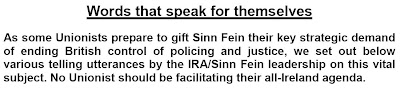
"As some Unionists prepare to gift Sinn Fein their key strategic demand of ending British control of policing and justice".
So, to the TUV, the Executive is not British, David Ford (if it is he) is not British … does Allister even see himself as British?
Words that speak for themselves, indeed!
Thursday 21 January 2010
Goodbye Scotland
A funny thing happened around the turn of the millennium. The flow of people between Northern Ireland and Scotland also turned. Back as far as the statistics are available (1991) the flow had been in Scotland's favour – more Northern Irish people moved to Scotland than the reverse. But in 2000 that changed, and Northern Ireland's ebb became a flow. In every quarter since 2000 Q2 more people have moved from Scotland to Northern Ireland than have moved from Scotland to Northern Ireland:

What could have caused this reversal of the flow? It would be nice to think that the Good Friday Agreement led many Northern Irish émigrés to return, but this is unlikely. People move for economic reasons, and rarely for ideological reasons.
Perhaps Scotland had become an unattractive place – economically and socially – following its devolution? This is also unlikely, as migratory flows between Scotland and England and Wales are very much in Scotland's favour. Over the period from 1991 to 2009 Scotland gained a net 320,000 people from England and Wales, but gained barely 800 from Northern Ireland.

So why are Northern Irish people no longer emigrating to Scotland in the same numbers?
Changes in funding arrangements for third-level education could be playing a part. Up-front tuition fees were abolished in Scotland in 2000 – but only for Scottish-domiciled students. Those from elsewhere in the UK had to pay fees (though, ironically, students from outside the UK, including the south of Ireland, were treated as 'local' students and paid no fees). This had the effect of encouraging Scottish students to stay in Scotland. The increased cost of going to university may have led more students to stay at home in Northern Ireland, thus greatly reducing the outflow to Scotland. With a reduced outflow, perhaps the underlying inflow from Scotland came to the surface. This still does not explain why there is an underlying positive inflow though. Some may be Northern Irish students returning after graduation, but who are the rest?
It will be interesting to see if this pattern continues, and if it does, whether it has any effect on Northern Ireland's increasingly close community balance. Scottish migrants could, after all, be either unionist-minded like Ian Paisley's parents, republican-minded like Pat Doherty MP MLA, or socialist like James Connolly.
Perhaps Scotland had become an unattractive place – economically and socially – following its devolution? This is also unlikely, as migratory flows between Scotland and England and Wales are very much in Scotland's favour. Over the period from 1991 to 2009 Scotland gained a net 320,000 people from England and Wales, but gained barely 800 from Northern Ireland.
So why are Northern Irish people no longer emigrating to Scotland in the same numbers?
Changes in funding arrangements for third-level education could be playing a part. Up-front tuition fees were abolished in Scotland in 2000 – but only for Scottish-domiciled students. Those from elsewhere in the UK had to pay fees (though, ironically, students from outside the UK, including the south of Ireland, were treated as 'local' students and paid no fees). This had the effect of encouraging Scottish students to stay in Scotland. The increased cost of going to university may have led more students to stay at home in Northern Ireland, thus greatly reducing the outflow to Scotland. With a reduced outflow, perhaps the underlying inflow from Scotland came to the surface. This still does not explain why there is an underlying positive inflow though. Some may be Northern Irish students returning after graduation, but who are the rest?
It will be interesting to see if this pattern continues, and if it does, whether it has any effect on Northern Ireland's increasingly close community balance. Scottish migrants could, after all, be either unionist-minded like Ian Paisley's parents, republican-minded like Pat Doherty MP MLA, or socialist like James Connolly.
Identity crisis
Regular readers of this blog will by now have realised that, in direct objective per capita comparisons, the south of Ireland is superior to the UK (and thus, by implication, to the north of Ireland). Index after index demonstrates that the south out-performs the UK economically, socially, in terms of freedom and peacefulness, and so on.
A rational person – one who seeks to maximise their own happiness and well-being – would seek to be part of the superior society. This, indeed, is what lies behind much of modern-day migration. But migration has costs as well as benefits – the financial cost of moving, the social cost of leaving your family and community, the risk of alienation or even violence in the new home, and the risk of capture and deportation for those migrants who are illegal. So in practice, most people do not migrate – most Mexicans stay in Mexico, and most Somalis stay in Somalia.
Almost uniquely in the world, though, the people of Northern Ireland have the legal power to migrate their whole territory from the inferior state to the superior one. The terms of the British-Irish Agreement (Article 1(iv)) state that:
So why do they not do it? Why does a very slender majority (soon to be only a plurality) continually vote to remain tied to the less free, less democratic, poorer and less contented state to their east?
The answer, of course, lies in the complicated area of identity.
Unionists are quick to point out that – regardless of the higher quality of life in the south – they wish to remain in the UK because they are British. Such a point of view cannot be argued away, as it is an emotional attachment rather than simply an economic one. Emotional attachments can withstand enormous counter-arguments – people are prepared to forego the possibilities of higher living standards, better health care, better climates, better education and so on, rather than change what they perceive themselves to be. Identity is complex – the election of Barack Obama in 2008 was greeted by black people worldwide as an election of 'one of their own' – despite the obvious facts that for non-Americans he was not 'one of their own' in terms of nationality, for black women he was not 'one of their own' gender, or for poor blacks he was certainly not 'one of their own' economically. Yet they felt a kindred spirit in terms of skin pigmentation.
A similar anomaly can be seen in Britain, where large numbers of migrants and children of migrants refuse to assimilate. They maintain their attachment to their places of origin despite the obvious economic superiority of the west. They retain strong attachments to repressive cultures despite the offer of western freedoms. They do this because they have a strong emotional bind to the identity that they were born into.
In the context of Northern Ireland this can be seen in the fact that despite long decades during which the economic situation south of the border was bad, and the north clearly offered a higher standard of living, most northern nationalists retained their Irish identities. Despite the constant jibes from unionists about how health and education were better in the north – even, on occasions, about how a can of Coke or a Mars bar was cheaper in the north – the vast majority of northern nationalists retained their sense of themselves as Irish, and kept alive the desire to see the reunification of their country, when times were better.
The lesson to be drawn from this is clear.
Identities are not easily changed by economic realities. In the 1950s northern nationalists did not become unionists. Similarly, in the 2000s northern unionists will not become nationalists. Despite all of the indices that this blog has publicised, probably not more than a handful of unionists have even started to question their unionism.
Likewise, unionist attempts to 'convert' nationalists by boasting about how being in the UK gives them access to all sorts of things are equally futile. Nationalists know, in any case, that all EU citizens have access to exactly the same sorts of things – there are no 'membership privileges' that being in the UK gives that are not shared or surpassed by EU membership.
The future of Northern Ireland, therefore, will not be decided by conversions from one tribe to the other. It will be decided by the relative sizes of the two tribes. Both tribes will retain their identities, but if one outnumbers the other, then the see-saw will swing. This blog offers a record of how the balance is changing – and in historical terms it is changing very fast. The growth in the nationalist electorate, and in its corresponding Catholic 'identity community', is remarkable over the past generation – and the corresponding decline in the unionist/Protestant 'identity community' is equally remarkable. Demographic changes have a momentum that is very slow to change, and it is likely that the Catholic/nationalist community will outnumber the Protestant/unionist community before the juggernaut slows down.
The best that the Protestant/unionist community can hope for is that it negotiates a decent place for itself in the new Ireland that will come. The good news is that, on the basis of the various indices on democracy, freedom and equality, it will find that easy to do.
A rational person – one who seeks to maximise their own happiness and well-being – would seek to be part of the superior society. This, indeed, is what lies behind much of modern-day migration. But migration has costs as well as benefits – the financial cost of moving, the social cost of leaving your family and community, the risk of alienation or even violence in the new home, and the risk of capture and deportation for those migrants who are illegal. So in practice, most people do not migrate – most Mexicans stay in Mexico, and most Somalis stay in Somalia.
Almost uniquely in the world, though, the people of Northern Ireland have the legal power to migrate their whole territory from the inferior state to the superior one. The terms of the British-Irish Agreement (Article 1(iv)) state that:
"… if in the future, the people of the island of Ireland exercise their right of self-determination on the basis set out in sections (i) and (ii) above to bring about a united Ireland, it will be a binding obligation on both Governments to introduce and support in their respective Parliaments legislation to give effect to that wish".A 'migration' of the whole of Northern Ireland – by reunification with the south – would remove all of the costs that physical migrants face. There would be no need for individuals to actually move, they would thus suffer no disruption to their family or community lives, and there would be no financial costs. Yet, almost immediately, they would benefit from their inclusion in a more modern, freer and more democratic state.
So why do they not do it? Why does a very slender majority (soon to be only a plurality) continually vote to remain tied to the less free, less democratic, poorer and less contented state to their east?
The answer, of course, lies in the complicated area of identity.
Unionists are quick to point out that – regardless of the higher quality of life in the south – they wish to remain in the UK because they are British. Such a point of view cannot be argued away, as it is an emotional attachment rather than simply an economic one. Emotional attachments can withstand enormous counter-arguments – people are prepared to forego the possibilities of higher living standards, better health care, better climates, better education and so on, rather than change what they perceive themselves to be. Identity is complex – the election of Barack Obama in 2008 was greeted by black people worldwide as an election of 'one of their own' – despite the obvious facts that for non-Americans he was not 'one of their own' in terms of nationality, for black women he was not 'one of their own' gender, or for poor blacks he was certainly not 'one of their own' economically. Yet they felt a kindred spirit in terms of skin pigmentation.
A similar anomaly can be seen in Britain, where large numbers of migrants and children of migrants refuse to assimilate. They maintain their attachment to their places of origin despite the obvious economic superiority of the west. They retain strong attachments to repressive cultures despite the offer of western freedoms. They do this because they have a strong emotional bind to the identity that they were born into.
In the context of Northern Ireland this can be seen in the fact that despite long decades during which the economic situation south of the border was bad, and the north clearly offered a higher standard of living, most northern nationalists retained their Irish identities. Despite the constant jibes from unionists about how health and education were better in the north – even, on occasions, about how a can of Coke or a Mars bar was cheaper in the north – the vast majority of northern nationalists retained their sense of themselves as Irish, and kept alive the desire to see the reunification of their country, when times were better.
The lesson to be drawn from this is clear.
Identities are not easily changed by economic realities. In the 1950s northern nationalists did not become unionists. Similarly, in the 2000s northern unionists will not become nationalists. Despite all of the indices that this blog has publicised, probably not more than a handful of unionists have even started to question their unionism.
Likewise, unionist attempts to 'convert' nationalists by boasting about how being in the UK gives them access to all sorts of things are equally futile. Nationalists know, in any case, that all EU citizens have access to exactly the same sorts of things – there are no 'membership privileges' that being in the UK gives that are not shared or surpassed by EU membership.
The future of Northern Ireland, therefore, will not be decided by conversions from one tribe to the other. It will be decided by the relative sizes of the two tribes. Both tribes will retain their identities, but if one outnumbers the other, then the see-saw will swing. This blog offers a record of how the balance is changing – and in historical terms it is changing very fast. The growth in the nationalist electorate, and in its corresponding Catholic 'identity community', is remarkable over the past generation – and the corresponding decline in the unionist/Protestant 'identity community' is equally remarkable. Demographic changes have a momentum that is very slow to change, and it is likely that the Catholic/nationalist community will outnumber the Protestant/unionist community before the juggernaut slows down.
The best that the Protestant/unionist community can hope for is that it negotiates a decent place for itself in the new Ireland that will come. The good news is that, on the basis of the various indices on democracy, freedom and equality, it will find that easy to do.
Yes to the Boyne Obelisk
The Boyne Foundation, a group supported by the Orange Order, which wants to replace the obelisk erected to commemorate the Battle of the Boyne, has been asked to resubmit its plans to Louth County Council. This does not imply any opposition to the plans from the Council, but merely a need for further information on a number of “major concerns” about the associated car park and picnic area.
As long as these concerns are satisfied, the plans should be approved.
The obelisk, which was over 50 metres tall, was erected in 1736, and blown up in 1923, probably by so-called republicans:

It should not have been blown up – true republicanism values the co-existence of all of Ireland's varied peoples, along with their cultures, symbols and languages. The Obelisk, though large and visible, caused no offence or disruption to the lives of those around, and merely commemorated an event of importance to the Orange portion of the Irish nation. Its reconstruction is to be welcomed, and this blog hopes that it will form part of a wider commemoration of this part of our history.
As long as these concerns are satisfied, the plans should be approved.
The obelisk, which was over 50 metres tall, was erected in 1736, and blown up in 1923, probably by so-called republicans:
It should not have been blown up – true republicanism values the co-existence of all of Ireland's varied peoples, along with their cultures, symbols and languages. The Obelisk, though large and visible, caused no offence or disruption to the lives of those around, and merely commemorated an event of importance to the Orange portion of the Irish nation. Its reconstruction is to be welcomed, and this blog hopes that it will form part of a wider commemoration of this part of our history.
Thursday 7 January 2010
Under one roof
It signifies nothing, of course, in legal or constitutional terms, but the news that the Office of the Northern Ireland Executive in Brussels has moved into the same building as the Irish Embassy has a certain symbolic value.
A message from the OFMDFM confirms that:
A message from the OFMDFM confirms that:
"We would like to inform that the Office of the Northern Ireland Executive has moved to new premises.While the Department of Foreign Affairs in Dublin confirms that its Brussels Embassy is located at:
Our new contact details are:
Office of the Northern Ireland Executive
180 Chaussée d'Etterbeek
1040 Brussels
Belgium"
Embassy of Ireland
Chaussee d'Etterbeek / Etterbeekse Steenweg 180
(5th Floor)
Bruxelles 1040 Brussel
Subscribe to:
Posts (Atom)




